

SHIMANO FINALLY MESSED WITH SPD-SL. HERE’S WHY THAT MATTERS.
Shimano introduced SPD-SL road pedals in 2003.
Think about that. The iPod was still impressive. Lance Armstrong still had all seven Tour victories. Most of us had considerably more hair.
Since then, road bikes have acquired electronic shifting, hydraulic disc brakes, power meters, radar, wireless everything and enough proprietary parts to make a mechanic quietly consider another profession.
Meanwhile, Shimano’s road pedal system mostly continued doing exactly what it was supposed to do: holding your feet to the bike without drama.
Now Shimano has finally redesigned it.
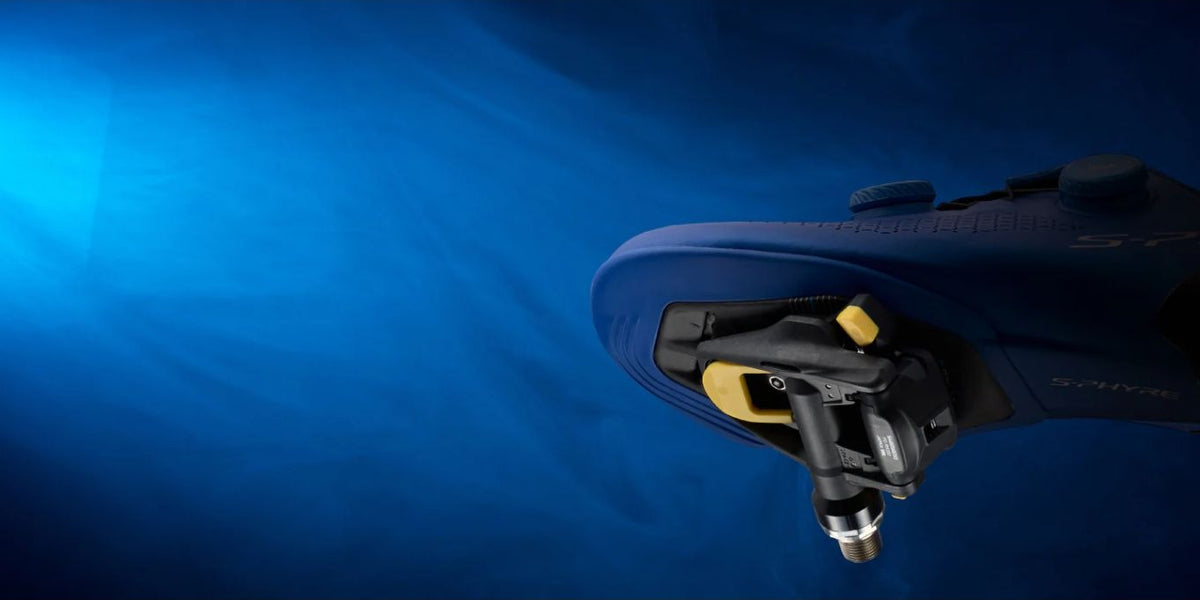
The new system is called SPD-SLR, and while the extra letter may not set your loins on fire, the changes are legitimate. Shimano redesigned the pedal, cleat and shoe interface to create a lower, more stable and easier-to-use connection between the rider and the bike.
In plain English: your foot sits closer to the pedal axle, clipping in is easier, and the entire system feels more direct.
Here’s What Actually Changed
Your foot sits 2.3 mm lower
Shimano reduced the stack height—the distance between your shoe and the pedal axle—by 2.3 mm.
That sounds like the sort of number invented to keep engineers entertained during lunch. On a bicycle, however, a few millimeters can matter.
Moving the foot closer to the axle creates a more stable platform with less leverage trying to rock the shoe from side to side. The result should be a firmer, more connected feel when climbing, sprinting or grinding away at threshold while pretending you are “just riding tempo.”
This is not going to magically add 30 watts. It can make the watts you already have feel more securely connected to the bike.
Clipping in should be easier
SPD-SLR uses a wider catch zone and reduces the engagement angle from 15.5 degrees to 10.5 degrees.
Translation: you should spend less time pawing at the pedal while leaving a stoplight.
That matters in racing, group rides and ordinary traffic. Quick engagement is one of those improvements nobody brags about on Instagram, but everyone appreciates when the light turns green and six people behind them are waiting to go.
The cleats are lighter
The new SPD-SLR cleats are up to 22% lighter than comparable SPD-SL cleats.
Is this going to change your life? No.
Are weight-obsessed road cyclists going to enjoy knowing it anyway? Obviously.
More important than the weight is the redesigned interface, which reduces unnecessary movement between the shoe, cleat and pedal.
Cleat installation makes more sense
The new cleats receive high-contrast alignment markings that make installation and repositioning easier.
This is a genuinely useful change. Cleat position affects knee comfort, hip alignment and pedaling mechanics. Being able to see exactly where the damn thing is mounted makes it easier to reproduce a good position when replacing worn cleats.
The New Pedals - Similar, but Different.

DURA-ACE PD-R9300
The new DURA-ACE PD-R9300 is the flagship SPD-SLR pedal.
It gets an injection-molded carbon-composite body, an extra-wide platform and an integrated stainless-steel contact plate. Shimano claims 11% greater stiffness and 53% less bearing resistance than the PD-R8200.
Will everyone feel those exact percentages? Probably not. But the broader platform, lower stack and more secure interface should create a noticeably solid connection—especially during hard accelerations and sustained high-output efforts.
This is the pedal for racers, performance-obsessed riders and anyone who has already spent an irresponsible amount of money on a bicycle and sees no reason to develop financial discipline now.

ULTEGRA PD-R8200
The ULTEGRA PD-R8200 brings the same basic SPD-SLR architecture to a less extravagant price point.
It uses a carbon-composite body, stainless-steel contact plate and the same new engagement system. For many riders, this will probably be the rational choice.
Naturally, that means half of you will buy DURA-ACE.
We understand.
Four Cleats—and One Decision That Actually Matters
SPD-SLR offers four cleat choices:

Red CL-SL100: Zero float
The foot is held in a fixed position.
This provides the most locked-in feel, but zero float is not automatically “more professional.” Unless your cleat position and biomechanics are properly sorted, your knees may submit a formal complaint.
Yellow CL-SL110: Six degrees of float
This is the sensible choice for the widest range of riders.
The additional movement can improve comfort and reduce joint stress, especially during long rides. Most riders do not need their feet held in carbon-fiber solitary confinement.
Blue CL-SL120: Two degrees of float
Blue sits between red and yellow, providing a firm, stable platform with a small amount of rotational movement. It is a good choice for riders who want a more controlled feel without going completely fixed.
Gray CL-SL130: The transition cleat
The gray cleat allows SPD-SLR pedals to work with most non-Shimano three-bolt road shoes.
It adds adjustment range for shoes with fixed mounting positions, but it does not deliver the same low-stack or weight benefits as the fully integrated SPD-SLR setup.
It is the bridge between the new Shimano pedals and shoes that were not designed specifically around them.
Let’s Discuss Compatibility Before Someone Orders the Wrong Thing
This is the important part:
-
New SPD-SLR cleats can be fitted to existing Shimano SPD-SL road shoes.
-
SPD-SLR pedals can also be used with many non-Shimano three-bolt shoes by using the gray CL-SL130 cleat.
-
The new SPD-SLR cleats are not compatible with older SPD-SL pedals.
-
The greatest stack-height and adjustment benefits come from using SPD-SLR shoes, cleats and pedals together.
So, no, Shimano has not made every road shoe you own obsolete.
But this is a new pedal interface—not merely an SPD-SL pedal with fresh graphics and a more expensive cardboard box. Make sure the pedals and cleats match before bolting an


Leave a comment
This site is protected by hCaptcha and the hCaptcha Privacy Policy and Terms of Service apply.