

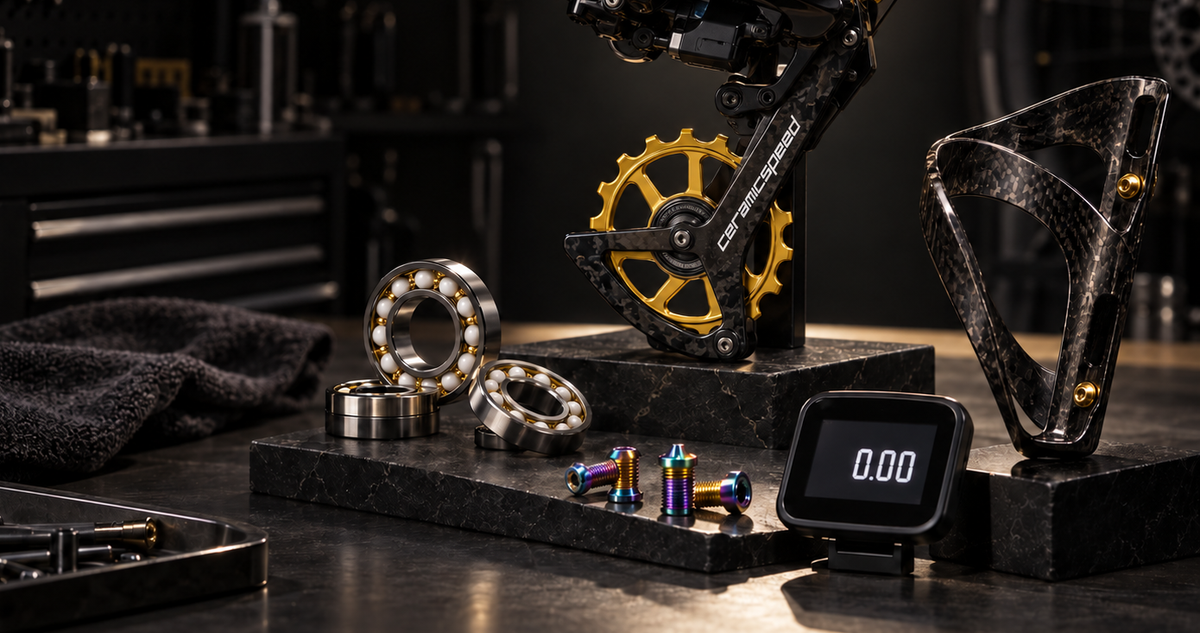
The $2,000 Upgrade That Made You 0.00 MPH Faster
Cyclists love upgrades.
We love researching them, buying them, installing them and then explaining—usually at exhausting length—why they have completely transformed the bike.
Sometimes they actually do.
Other times, we’ve spent $2,000 to make a perfectly good bicycle slightly more complicated and 73 grams lighter. Congratulations. You have removed the approximate weight of a fun-size Snickers from a machine carrying a fully grown adult.
Before the angry emails begin, let me be clear: I like expensive bike parts. Winter Park Cycles sells expensive bike parts. Some of them are spectacular. And there is absolutely nothing wrong with buying something simply because it’s beautiful, beautifully made or makes you happy.
But let’s not confuse jewelry with speed.
Ceramic Bearings: Because Regular Bearings Are Apparently Barbaric
Ceramic bearings are the official gateway drug to marginal-gain insanity.
Yes, high-quality ceramic bearings can reduce friction. In the right conditions, installed correctly, properly maintained and compared with mediocre steel bearings, the improvement can be measured.
Measured.
That word is doing a lot of work.
On a laboratory test rig, the difference may exist. On the road—where your chain is dirty, your jersey is flapping, your tires are six PSI too hard and you’re sitting upright telling someone about your ceramic bearings—the benefit can become nearly meaningless.
If your current bearings are worn, gritty or manufactured from recycled lawn furniture, replacing them will absolutely help. But the important improvement comes from replacing bad bearings with good bearings. The ceramic part is often the expensive garnish.
Buy them if you appreciate the engineering. Just don’t expect woodland creatures to start singing when you pedal.
Oversized Pulley Wheels: The Peacock Feathers of the Peloton
Nothing says “I take drivetrain efficiency seriously” quite like a derailleur cage large enough to serve dinner on.
Oversized pulley-wheel systems can reduce drivetrain friction slightly. The larger wheels require the chain to articulate less sharply, and a well-designed system can produce a small efficiency gain.
Again: small.
They also look cool. They make your bike appear extremely serious while it leans against the coffee-shop wall. For many riders, that is at least 70 percent of the appeal, and I respect the honesty of anyone willing to admit it.
But if your chain resembles something recovered from the bottom of a canal, the oversized pulleys aren’t saving you. Clean and lubricate the drivetrain first. A fresh, properly maintained chain will do more for performance than hanging a dinner plate off the derailleur.
The Top-Tier Groupset Upgrade
Modern second-tier electronic groupsets are ridiculously good.
Shimano Ultegra Di2 and SRAM Force AXS shift beautifully. They’re fast, reliable and more sophisticated than the professional equipment we once considered miraculous.
Moving to Dura-Ace or RED may save weight. It may improve ergonomics, braking feel, finish or component design. Those things can matter, especially when you care deeply about how a bike feels.
But it probably will not turn you into a different rider.
You aren’t getting dropped because your rear derailleur is 70 grams too heavy. You’re getting dropped because Kevin has been training consistently since February while you’ve been watching videos about rear derailleur weight.
The top group is nicer. It may be a lot nicer. Buy it because you want the best—not because you believe your Wednesday-night group ride is being decided by the crank-arm finish.
Carbon Bottle Cages, Titanium Bolts and Other Tiny Miracles
There comes a point in every weight-weenie build when someone spends $160 to save 18 grams.
This is when the project has stopped being transportation and become performance art.
Carbon bottle cages can be beautiful. Titanium hardware is cool. Ultralight thru-axles exist. There are people replacing perfectly functional bolts one at a time as if assembling a two-wheeled space program.
Does reducing weight matter? Certainly. But where you remove it, how much you remove and what you sacrifice to do it all matter too.
Saving a pound from a heavy wheelset can change how a bike accelerates and feels. Saving 11 grams from a stem faceplate mostly changes your checking-account balance.
And please don’t replace structurally important hardware with random internet titanium because someone on a forum named AeroDaddy69 said it was fine.
The Ultralight Saddle That Hates You
A brutally light saddle looks fantastic on a scale.
Unfortunately, you do not ride the scale.
If a saddle causes you to move constantly, unload one side, shorten your rides or avoid the bike entirely, it is not a performance upgrade. It’s an expensive carbon punishment device.
Comfort is not the enemy of speed. Stability and comfort allow you to hold an effective position longer. A saddle that weighs 60 grams more but lets you pedal properly for four hours is faster than a carbon potato chip that makes you reconsider cycling after 45 minutes.
Your ass does not care about the catalog weight.
Replacing a Good Carbon Cockpit With a Slightly Better Carbon Cockpit
Integrated cockpits can improve aerodynamics, stiffness and appearance. They can also make a bike look far cleaner.
But replacing an already excellent cockpit with another one because it is 40 grams lighter and allegedly 3.6 percent stiffer may accomplish very little—especially if the new dimensions compromise your fit.
Aero matters. Position matters more.
A rider who is comfortable and stable in a sustainable aerodynamic position will usually outperform one who has chosen a cockpit based on aggression, vanity and a complete rejection of cervical anatomy.
Never sacrifice a good position to make the bike look faster while parked.
Upgrades That Actually Matter
Here is the annoying part: the most useful improvements are often less glamorous.
A proper bike fit can improve comfort, power delivery and your ability to stay aerodynamic.
The right tires, correctly sized and inflated, can transform speed, grip and ride quality.
A clean drivetrain with a fresh chain wastes less energy and preserves expensive components.
The right wheels can make a meaningful difference—particularly when they improve aerodynamics, tire compatibility or handling without creating new problems in crosswinds.
A well-fitting skinsuit or jersey can produce a far more useful aerodynamic improvement than many tiny mechanical upgrades.
And training works incredibly well, which is unfortunate because it cannot be purchased with Apple Pay and installed in fifteen minutes.
So Should You Buy the Ridiculous Upgrade?
Maybe.
There is value beyond stopwatch performance. Mechanical beauty has value. Craftsmanship has value. Loving your bike enough to ride it more has value.
Sometimes you want the absurd derailleur cage. Sometimes only the top-tier groupset will make the build feel complete. Sometimes you want titanium bolts because they’re titanium bolts, dammit.
That is reason enough.
Just be honest about what you’re buying.
If you want measurable speed, start with fit, position, tires, pressure, clothing, drivetrain condition and the parts that genuinely affect how the bike performs.
If you want a gorgeous piece of unnecessary engineering, we can help with that too. We enjoy bike jewelry as much as anyone.
At Winter Park Cycles, our job isn’t to tell you that every expensive component will change your life. It’s to explain what you’ll actually feel, what you probably won’t, and whether the improvement is worth the money to you.
Because the only thing worse than an expensive upgrade that accomplishes almost nothing is buying one without realizing it.


Leave a comment
This site is protected by hCaptcha and the hCaptcha Privacy Policy and Terms of Service apply.